
Search Wakefield Streets by Parcel
A whole-street search starts with the Town assessor, not a name search. Patriot Properties can return a run of parcels for one street, while its detail record connects an address to a parcel ID, an assessed owner, sale information, and a registry book/page reference. Copy the situs, or property, address exactly. Keep the parcel ID and legal description with it. Those details are steadier than a name or a mailing line when a street has apartments, trusts, or a later sale.
Use the street result as an address index, then treat each source as a different kind of evidence. The assessment entry is the current Town tax record. MapGeo places the lot on the street. The registry supplies recorded instruments. A municipal voter list or annual street list can add a dated resident record, but neither is a complete household roll. For older households, the local history collections can supply a directory, street-list, or newspaper lead.
- Run the street name in Wakefield Patriot Properties and save the parcel ID, situs, owner, sale fields, and book/page for the relevant row.
- Open the parcel detail to compare the legal description and map reference with the street result. A care-of or mailing line can differ from the property location.
- Locate the parcel in Wakefield MapGeo and inspect its position among the street’s mapped lots.
- Use the book/page or legal description in MassLandRecords for Middlesex South to find the recorded deed and its parties.
- For a dated resident lead, request the appropriate municipal list or consult Beebe’s historical street lists, directories, and newspapers. Keep the source date beside the address.
Note: A parcel sequence is useful for studying a street, but it is not a list of everyone living at each door.
Wakefield Street Directory in Patriot
Patriot’s FY2026 assessment search offers three documented modes: Street Name, Owner Name, and Parcel ID. Street and owner searches accept the first few letters before the search is run. Parcel ID uses the map number. The Town says the FY2026 assessment reflects ownership and assessment changes as of January 1, 2025 and sales during calendar year 2024. That makes it a current assessment reference, not a claim about every present occupant.
| Patriot search field | Input | How it works | Street-directory use |
|---|---|---|---|
| Street Name | Text | First few letters accepted; results can paginate | Browse parcels on one named street |
| Owner Name | Text | First few letters accepted; name variants and trusts matter | Connect an assessed owner to another parcel search |
| Parcel ID | Text | Enter the map number or parcel ID | Return to one parcel after a street result |
| Parcel detail | Linked result | Follow the parcel ID from the result table | Check legal description, characteristics, and registry reference |
The official Water Street street result shows why this is a strong street-by-street tool. Its table exposes Parcel ID, Location, Owner, Built, Type, Total Value, Beds, Baths, Lot Size, Finished Area, LUC, Description, Neighborhood, Sale Date, Sale Price, and Book/Page. It has sortable headings, multiple pages, and a next-page path. Record the page as well as the fields, especially on a long street.
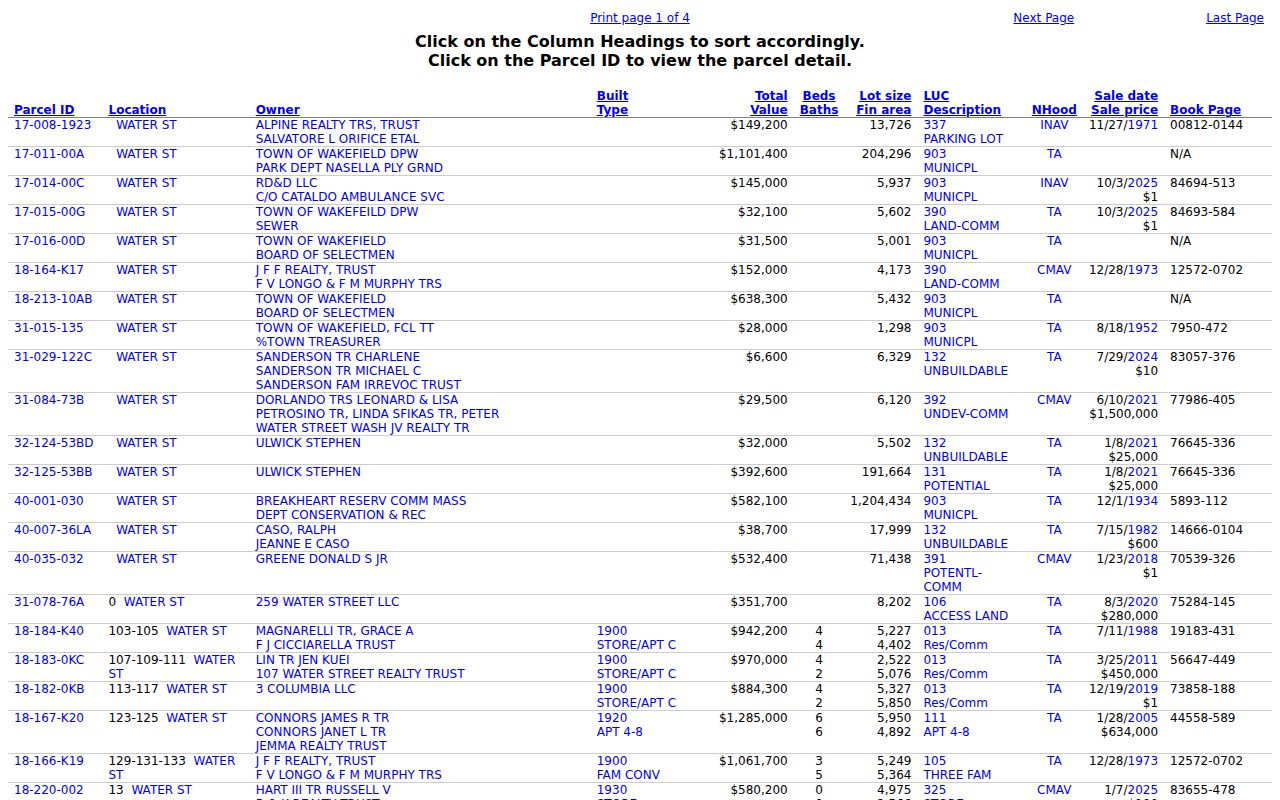
The assessor display turns a street name into comparable parcel records, but the owner column and mailing notation still describe an assessment connection, not verified physical residence.
- Parcel ID
- The Town’s identifier for a mapped tax parcel. It is the safest key for returning to the same assessment record.
- Situs address
- The physical property location shown as Patriot’s Location field. It can differ from an owner’s mailing address.
- Legal description
- The deed’s formal land description, often tied to a lot, plan, or boundaries. It helps when an older street number is uncertain.
- Criss-cross directory
- A reverse-style directory arranged by address or street rather than surname. No separate Wakefield title was verified, so ask Beebe staff about available street sections or reverse volumes.
MapGeo Places Wakefield Street Records
Wakefield MapGeo is the Town’s interactive parcel viewer, and the Town property page also links PDF assessor maps. Search or pan to the street in a browser, click the target parcel, and compare the lot with its immediate neighbors and street segment. Then follow the assessor or property connection for the parcel being studied. That map context can expose a boundary, a corner location, or a lot pattern that a plain street-table row cannot show.
The viewer is a geographic bridge between parcels, not a confirmed list of residents. Its dynamic layer names, search controls, measuring tools, exports, and popup fields were not verified in the research, so they should be checked live before relying on a particular control.
MassGIS included Wakefield in a July 2025 municipal property-tax parcel release. That statewide source can help cross-check parcel geography, but the Town’s current assessment record and MapGeo remain the appropriate Wakefield sources for a current street query.
Wakefield Street Lists and Voter Files
Two local records are easy to confuse. Wakefield’s annual street list comes from returned annual census forms and publishes names and addresses for residents age 17 and older. It is not the voter list. The annual form also has household, moved or deceased, optional mailing-address, party, telephone, and signature fields, while the public street list reflects the Town’s annual census work. Nonresponse for two consecutive years can affect active voting status, which is another reason the two records have different purposes.
A municipal voter list is requested from Wakefield election officials, rather than from the state polling-place form. Massachusetts identifies public voter-list fields including name, address, party, date of birth, active or inactive status, and voter ID, with additional requestable registration and participation fields. Phone, email, confidential-voter data, minor-related records, and other protected information may be withheld. The Where Do I Vote tool accepts an address or ZIP route to return polling-place and precinct context. It is not a person-name directory.
This contrast matters for a street directory. A street list can give a dated resident lead for people 17 and older who appear through the annual census process. A voter file identifies registered voters in the requested record, not every resident of a street. Ask the Town Clerk or election officials for the desired date or election cycle, the needed format, and only the fields required for the research question.
Note: Protected addresses and confidential voter records must remain protected even when another public source names the same street.
Deeds Behind a Wakefield Street
The Middlesex South Registry of Deeds holds recorded land instruments for Wakefield. Its official registry information says recorded documents can be viewed, copied, and downloaded free online. MassLandRecords divides its searches among Recorded Land, Registered Land and Land Court, Plans, and Registered Land Plans. Recorded Land includes Name, Document, Book, Property, Recorded Date, and an Unindexed Property Search for Book 1–1024. The exact first year of online indexing was not found, so do not assume a year boundary.
For an address record, begin with the assessor’s book/page and legal description. The registry search can narrow by party, document type, town, and recorded-date range. Search the current buyer as a grantee for the purchase instrument; the seller, or grantor, becomes the next historical grantee to search. Check plans and registered land separately where the title suggests them. If a deceased owner interrupts the sequence, probate may supply a useful next lead.
The Middlesex South Registry provides the source page for its public search and copy rules.
Free online images are useful for a street-history trail. A certified copy is a different product: the registry lists certified copies at $1 per page, available in person at the Welcome Desk, by mail, or by email request for pickup. The registry counter is the fallback for early or unindexed material.
Wakefield Street Address Records
Each address system answers a narrow question. The parcel assessment ties an owner and property characteristics to a situs. The map gives parcel geometry. A deed records a legal transaction. Local lists may add a dated resident or registration record. Permit files may name an applicant or owner. Keeping those roles separate prevents a street directory from overclaiming what one row can establish.
| Address record | Wakefield keeper | Fields useful by street | Access and limit |
|---|---|---|---|
| Parcel assessment | Patriot Properties | Owner, situs, mailing/care-of, parcel ID, sale and book/page fields | Free FY2026 search; no household list |
| Mapped parcel | MapGeo | Parcel geometry and street context | Free dynamic viewer; controls remain partly unverified |
| Recorded deed or plan | Middlesex South Registry | Parties, legal description, dates, book/page, image | Free search and images; certified pages cost $1 each |
| Annual street list | Wakefield Town Clerk | Names and addresses for residents 17 and older | Annual-census publication; not the voter list |
| Municipal voter list | Wakefield election officials | Registered voter name, address, status, party, and other allowed fields | Local request; confidential fields withheld |
| Permit or code file | Inspectional Services and RAO | Address, applicant or owner, plans, dates, decisions | Request by address and date range; online building access is incomplete |
Historical household work belongs in directories, annual street lists, and newspapers rather than an assessment card alone. The more complete collection discussion appears with the Wakefield city directories, where the holdings and dates can be matched to a particular address trail.
Wakefield Permit Files by Address
Inspectional Services describes Viewpoint Cloud applications for many permit types, but the research did not confirm a public address-result screen for historic building records. Building applications were not fully online at the inspected page. The Town describes permanent files by street address that can include applications, supporting documents, plans, dates, fees, decisions, issued or denied permits, and violations.
For a historic file, use the Wakefield public-records request route through the Records Access Officer. State the street address, approximate date range, and requested document types. The form asks for a name, email, phone, and description of the records requested. A narrow request makes it easier for the custodian to identify the permanent address file without turning an address search into a guess.
South Reading in Wakefield Street Records
A present-day street name is not always the best starting term. Historical Society material identifies a sequence that includes Redding and South Reading before the Town became Wakefield on July 4, 1868. Earlier jurisdictional research can also lead to Reading or North Reading repositories. Search the historical place name alongside a street, cross-street, corner notation, or legal description when an early deed, directory, or newspaper does not respond to the modern town name.
This is a Wakefield research quirk, not a reason to invent a renumbering date. No official street-renumbering year, annexation map, or ZIP realignment was located. An address-number match across a long period is only a working hypothesis until a legal description, mapped lot, directory street section, or nearby property confirms continuity.
Book 1–1024 and Street Comparisons
MassLandRecords labels an Unindexed Property Search for Book 1–1024. That visible option is a useful warning against treating current search behavior as the rule for every earlier street record. The research did not verify an online starting year. When a current name, book/page, or property query ends without the older conveyance, use the unindexed route and ask the registry counter about the appropriate book, plan, or copy procedure.
The difference between a free online image and a certified page is equally important. An image helps compare names, dates, legal descriptions, and plan references across a street. A certified page is obtained from the registry when a certified record is actually required. This comparison keeps a historical street search grounded in the registry’s own record products.
Limits on Wakefield Street Records
A street directory can document a parcel, a recorded owner, a dated directory entry, or a registered voter when the relevant record is available. It cannot prove a complete household at every address. Owner mailing lines can be elsewhere. Utility customer lists, private delivery data, and confidential voter information are not ordinary public street records. A deed or assessment row should never be read as proof that every person at the situs is present or listed.
Lawful use. Use Wakefield address records for personal, lawful research such as family history or property questions. Do not use them to stalk, harass, harm, or attempt to identify a protected address.
When the goal changes from the whole street to one person’s official records, use the appropriate municipal, registry, court, or state custodian instead of trying to fill the gap from a street-level result.