
Wakefield Previous Residents by Era
An address history needs different sources for different periods. The present assessor card leads to a current owner and parcel reference. Recorded deeds provide ownership chronology. Directories and annual street lists provide dated household leads. Newspapers and death records can explain a disappearance from a local list. Maps and legal descriptions help decide whether a similar street number refers to the same place.
| Source | Years it covers | Where held | What it contributes |
|---|---|---|---|
| FY2026 assessor | Current FY2026, with ownership changes as of January 1, 2025 and sales during 2024 | Wakefield Patriot Properties | Current owner, situs, characteristics, sale fields, and book/page |
| MassLandRecords | Current online data; Book 1–1024 has an unindexed mode, with no verified first online year | Middlesex South Registry | Deed chain, plans, recorded dates, mortgages, liens, and images |
| Town permit files | Permanent files; exact digital start not located | Inspectional Services and Town RAO | Applications, plans, decisions, and issued or denied status |
| Wakefield directories | 1869–1997 in the State Library holdings guide; regional scan metadata 1909–1941 | State Library, Beebe, and Internet Archive | Household notation, address, occupation, and institutions |
| Wakefield street lists | 1919 onward finding aid | NOBLE, Beebe, and Town | Residents 17 and older and annual-response context |
| Death database and Census | Deaths 1850–2016; federal Census public through 1950 | Beebe and library database routes | Name/date details and household composition |
| Newspapers and Sanborn maps | Daily Item 1894–2025; maps verified for 1887, 1892, and 1897 | Beebe, Advantage Preservation, and Library of Congress | Notices, events, building footprint, and use |
Begin in the era closest to the question, but retain the current parcel data throughout. A later deed can make an earlier name searchable; an older directory entry can make a newspaper or probate search more precise. Neither a missing listing nor a changed owner should be treated as a final answer by itself.
Freeze the Wakefield Address First
Before searching for past residents, record three identifiers from Wakefield Patriot Properties: the current situs address, parcel or map identifier, and legal description. Also retain the current owner, sale date or price where shown, and book/page. Patriot’s Location field is the property situs. An owner’s care-of or mailing line can be somewhere else, so it is a lead for correspondence or ownership research, not proof of who occupied the property.
These three identifiers prevent a common address-history error. A street number can change, a parcel can be divided, and a historical directory can use a corner or cross-street. The legal description and plan references are stronger continuity checks when an old source does not match the modern number. For a trust, estate, or corporation, preserve the exact name and punctuation as shown before moving to the registry.
- Grantor
- The party transferring an interest in a recorded deed, often the seller in a conventional conveyance.
- Grantee
- The party receiving the interest in a recorded deed, often the buyer. A current seller becomes the next person to seek as an earlier grantee.
- Chain of title
- The sequence of recorded transfers connecting owners of the same property through time.
- Legal description
- The formal land description in a deed or plan. It is more durable than a street number when historic addressing is unclear.
Walk Back a Wakefield Deed Chain
Middlesex South Registry of Deeds is Wakefield’s regional recorder. Use the current owner and book/page from the assessor card in MassLandRecords, then open the purchase instrument. The portal supports Recorded Land, Registered Land and Land Court, Plans, and Registered Land Plans. Its recorded-land family includes Name, Document, Book, Property, Recorded Date, and Unindexed Property searches.
- Copy the current owner, parcel ID, legal description, sale fields, and book/page from the assessor record.
- Locate the current conveyance in MassLandRecords by party, book/page, property, town, document type, or recorded-date range where supported.
- Record the grantor, grantee, recorded date, deed type, book/page or instrument link, any plan reference, and the legal description.
- Search the seller or grantor as an earlier grantee, then repeat the same comparison for the prior conveyance.
- When the chain reaches a trust, estate, or registered-land clue, search the exact legal name, the related plan or certificate, and Probate if a deceased owner interrupts the record.
Free registry images can be viewed, copied, and downloaded online. They are not certified copies. The registry lists certified copies at $1 per page, available in person at the Welcome Desk, by mail, or by email request for pickup. The counter is the documented fallback when an older book or image needs assistance.
Wakefield Previous Residents in Unindexed Books
The registry labels an Unindexed Property Search for Book 1–1024. That is an important Wakefield research quirk: the exact first year of online indexing was not located, so a modern property search does not prove that an earlier transfer is absent. Try the unindexed route, retain the legal description and plan references, and ask the Middlesex South counter which book, plan, or request path is appropriate for the older record.
A plan can resolve an address problem that a deed name search cannot. Plans are a separate MassLandRecords search group, and a lot split or boundary change may be easier to follow through plan images than through a street-name field. Compare the plan ID, book/page, municipality, adjoining lot language, and legal description before treating two address strings as the same property.
Note: Free index and image access helps research, while a certified page is a separate registry product with its own copy procedure.
Wakefield Past Households in Local Lists
Ownership is only part of an address history. Wakefield city and town directory holdings begin with 1869 and continue in listed intervals through 1997; the State Library holdings guide should not be read as proof that every listed volume is digitized or immediately available. The regional Wakefield, Stoneham, Reading, North Reading, and Lynnfield directory has scanned-volume metadata spanning 1909–1941. Its alphabetical, street, town-government, and society sections can connect a person to a street or corner notation.
Wakefield street lists have a NOBLE Digital Heritage finding aid from 1919 onward, and hard copies are held in the Beebe Local History Room. They are annual-census records for residents 17 and older, not a complete household census or a voter list. The library’s local history room, microfilm, maps, directories, newspapers, death database, scanning support, and reference service form the documented house-history route, even though no separate house-history guide was located.
The NOBLE Digital Heritage Wakefield street-list collection is the source for the collection finding aid.
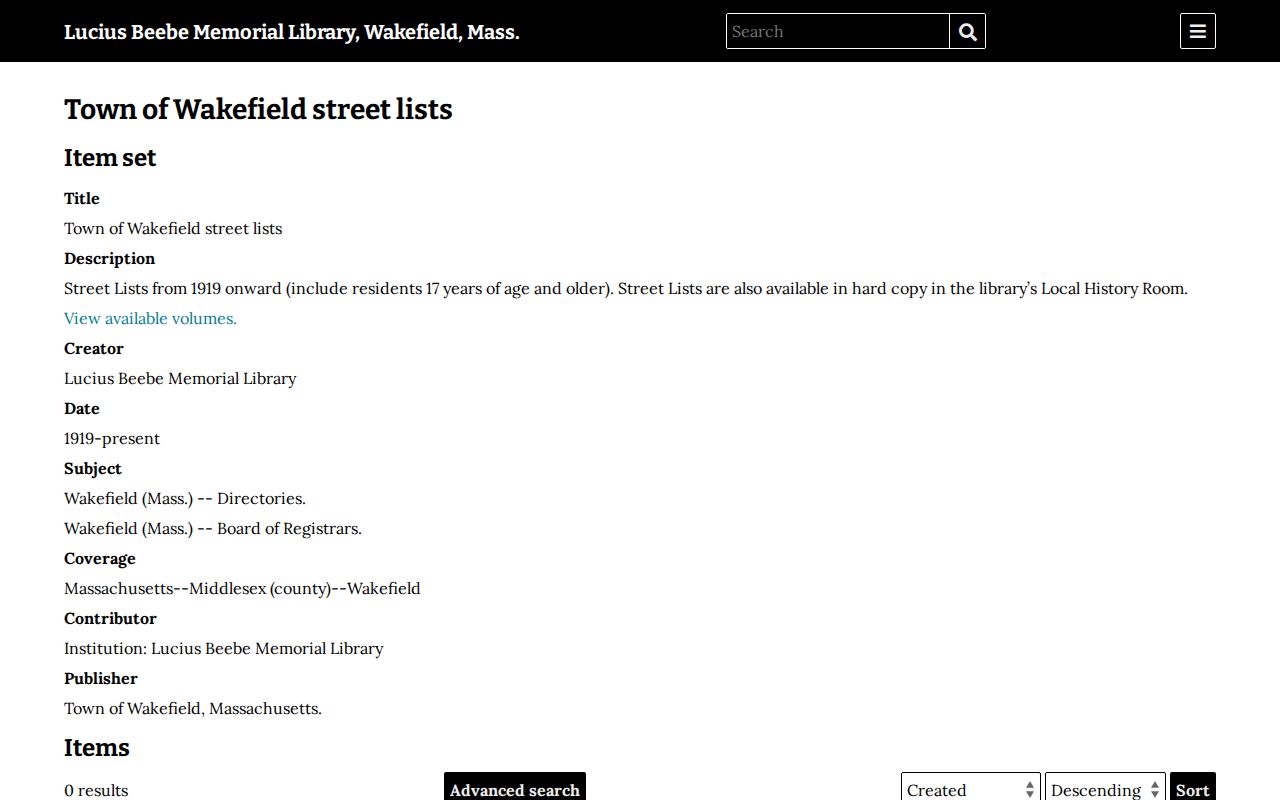
The collection gives a dated local-list route, while Beebe staff can help confirm which hard-copy or digitized volume is available for a needed year.
- Record the directory or street-list year, page, exact name, address wording, and whether the entry is alphabetical or in a street section.
- Compare the next available volume rather than assuming every year survives or was published.
- Pair a directory date with the appropriate federal Census release, recognizing that a Census is a single enumeration date and a directory can be annual.
- When a name disappears, search the Daily Item, Beebe death index, probate, cemetery material, or the next deed rather than assuming departure or death.
Sanborn Maps for Wakefield Previous Residents
Sanborn maps do not name every person, but they put a building back into the address trail. The Library of Congress has verified Wakefield sheets for July 1887, June 1892, and January 1897. Compare the building footprint, material, use, street name, and nearby lots with the directory entry and the deed’s legal description. A map can show whether a place was a dwelling, store, factory, or other structure before a household conclusion is drawn from a name alone.
The 1887 Wakefield Sanborn viewer is one verified starting sheet. The research also confirms the 1892 and 1897 Library of Congress sheets. Use them to test continuity, not to create an unverified renumbering history.
South Reading and Wakefield Past Residents
The historical place-name sequence is essential for a deep address search. Historical Society material places Redding before South Reading, with the town becoming Wakefield on July 4, 1868. For pre-1868 material, search South Reading as well as Wakefield. For the earlier jurisdictional period, check Reading and North Reading repositories. A deed, directory, or newspaper that fails under the modern name may simply be using the earlier one.
No official Wakefield street-renumbering or ZIP-realignment record was located. Do not supply a date that the records do not support. Use cross-streets, corner descriptions, legal descriptions, Sanborn maps, and adjoining owners to bridge names and numbers. A number match across a century is a hypothesis until the lot or street section confirms it.
Wakefield Permits, Notices, and Estates
Permanent Town address files can add a dated endpoint to a deed chronology. Inspectional Services describes files containing applications, supporting documents, maps or plans, dates, fees, decisions, and issued or denied status. Building applications were not fully online at the inspected page, and no public historic address-result interface was confirmed. Request a defined street address and date range through the Town Records Access Officer rather than relying on an unverified portal search.
Wakefield’s Daily Item run covers 1894–2025 and the older Citizen titles reach 1872. Newspaper notices can supply death, property-sale, society, or business context, but OCR needs surname variants and date windows. Beebe’s death database covers about 31,600 deaths from January 1850 through December 2016. An obituary may identify relatives; a probate estate can then identify a fiduciary or heir; the next deed can test whether title changed. This is corroboration, not proof that every listed relative lived at the address.
Limits on Wakefield Previous Residents
A past-resident trail can show recorded owners and dated household leads, but it cannot establish a complete household for every year. An assessment owner may have a different mailing address. A directory can omit a person, and a street list records a particular annual process. The owner, resident, mailing address, and deed party should remain separate facts in any chronology.
Lawful use. Use Wakefield address history for family history, estate questions, and personal property research. Do not use historic or current information to stalk, harass, harm, or track a living person.
The directory holdings themselves are detailed in the Wakefield city directory collections. That route is useful when the address trail needs a specific volume, abbreviation key, or local-history access question.