
Looking Up Wakefield Neighbors
The closest public view of a Wakefield block comes from several records with distinct limits. MapGeo supplies parcel geometry and street context. Patriot Properties supplies the assessment row connected to a parcel. Middlesex South deeds can answer a specific legal-history question. A municipal voter-list request may show registered voters at nearby addresses, while Beebe’s community directory points to local institutions. None of these sources is a complete list of every person around an address.
| Source | What it shows about a block | Access |
|---|---|---|
| Wakefield MapGeo | Target and surrounding parcel geometry, street labels, and map context | Free dynamic viewer; current controls need browser confirmation |
| Patriot Properties | Parcel ID, situs, owner, mailing or care-of line, sale and book or page reference | Free public assessment search; owner is not every occupant |
| Middlesex South Registry | Selected parcel’s grantor, grantee, legal description, recording date, and image | Free index and images; certified copy route is separate |
| Wakefield municipal voter file | Registered voter name, address, party, date of birth, status, and voter ID when lawfully requested | Local request; protected fields and records withheld |
| Street lists and directories | Historical address and age-17-plus municipal enumeration leads | Town and library collections; not a complete household roster |
| Beebe community directory | Named civic and community organizations with public organization information | Public directory categories; no private membership roster |
Read the owner and resident questions separately. A parcel result can associate an owner with a recorded or assessed property, while an address line can be a situs, a mailing address, or a care-of line. It does not establish every person who stays at that location.
Map Wakefield Neighbors by Parcel
Use an adjacent-parcel approach in MapGeo. Center the viewer on the target address, click its parcel, and inspect the immediately surrounding geometries and street labels. Follow each selected parcel to the assessor detail and record only the fields that help distinguish parcels. The text inspection did not expose MapGeo’s live search, identify, measure, select, buffer, zoning, flood, district, or export controls, so those tools should be confirmed in the current browser view rather than assumed.
- Locate the target address in MapGeo and note the parcel shape and nearby street labels.
- Click each immediately surrounding parcel and record the parcel ID and situs in one row per parcel.
- Open the matching Patriot record for owner, mailing or care-of distinction, sale reference, and book or page field.
- Use the Registry for a selected adjacent parcel only when a deed or legal-description question needs an answer.
- Stop the block list at the neighboring parcels rather than turning it into a broad title search.
The flow is address to target parcel to surrounding parcels to assessor records to a selected deed question. For an entire named street rather than an immediate block, the Wakefield streets reference uses the wider address chain.
Wakefield Neighbors Evidence Table
A compact evidence table prevents a map click from becoming a loose identity claim. One row should represent one parcel, with columns that describe the source and date. Leave a field blank when the source does not show it. The parcel ID and legal reference are usually better comparators than a name alone, especially when an owner record includes a trust, entity, care-of notation, or a mailing line outside Wakefield.
| Parcel ID | Identifier copied from the assessor result for the target or adjacent parcel. |
|---|---|
| Situs | The physical property location shown in the assessment record. |
| Owner and mailing line | Assessing information that must remain distinct from a physical-occupancy conclusion. |
| Book or page | Registry reference used to find a selected instrument or related legal description. |
| Access date and source | The portal or custodian and the date the row was consulted. |
The same method supports a scam check. If an unexpected deed notice appears, compare the official Registry instrument and assessor parcel instead of relying on a letter or an unfamiliar intermediary.
Wakefield Neighbors and the Voter File
Massachusetts makes municipal voter-list information available through local election offices, but the public and withheld fields matter. A requested municipal list can include name, address, party, date of birth, active or inactive status, and voter ID. The Secretary also describes additional registration and election-history fields that may be available. Phone, email, confidential-voter data, and certain minor or protected information may be withheld.
The Where Do I Vote tool is not the name-search route. It takes an address number, street name, suffix, and either a city or town or ZIP to return precinct and polling-place context. A municipal voter list identifies registered voters at the requested time. It does not establish the full set of people at an address, and a missing name can reflect timing, registration, a returned census form, or a protected record.
Wakefield Neighbors Community Contacts
Wakefield’s Community Involvement information is a public route to local civic activity. Beebe’s Join In Wakefield directory adds a directory layer without claiming private membership. The organizations below are documented community or historical resources. A listed organization provides a contact or research lead, not a roster of people connected to a block.
| Organization | Documented local relevance | Public contact or roster status |
|---|---|---|
| Wakefield Center Neighborhood Association | Center and downtown civic coordination | Public organization contact exists; no member roster located |
| Friends of Lake Quannapowitt | Lake stewardship and community events | Public group name and activities; no private membership list located |
| Crystal Community Club | Crystal-area community organization | Listed by Beebe; no public roster located |
| Hartshorne House Association | Historic-site and community layer | Public contact through organization or library directory; no roster located |
| Wakefield Historical Society | Town maps, documents, and address-history assistance | Public museum and research contact; collection access by inquiry |
| Wakefield Garden Club | Civic and environmental community network | Listed in Beebe and Town sources; no member roster located |
| Wakefield Civic League | Civic discussion and local participation | Listed in Beebe and Town sources; no private roster located |
| Wakefield Main Streets | Downtown business and community activity | Town program contact; no member list located |
The Town’s Community Involvement page is the source for this public-facing civic-layer capture.
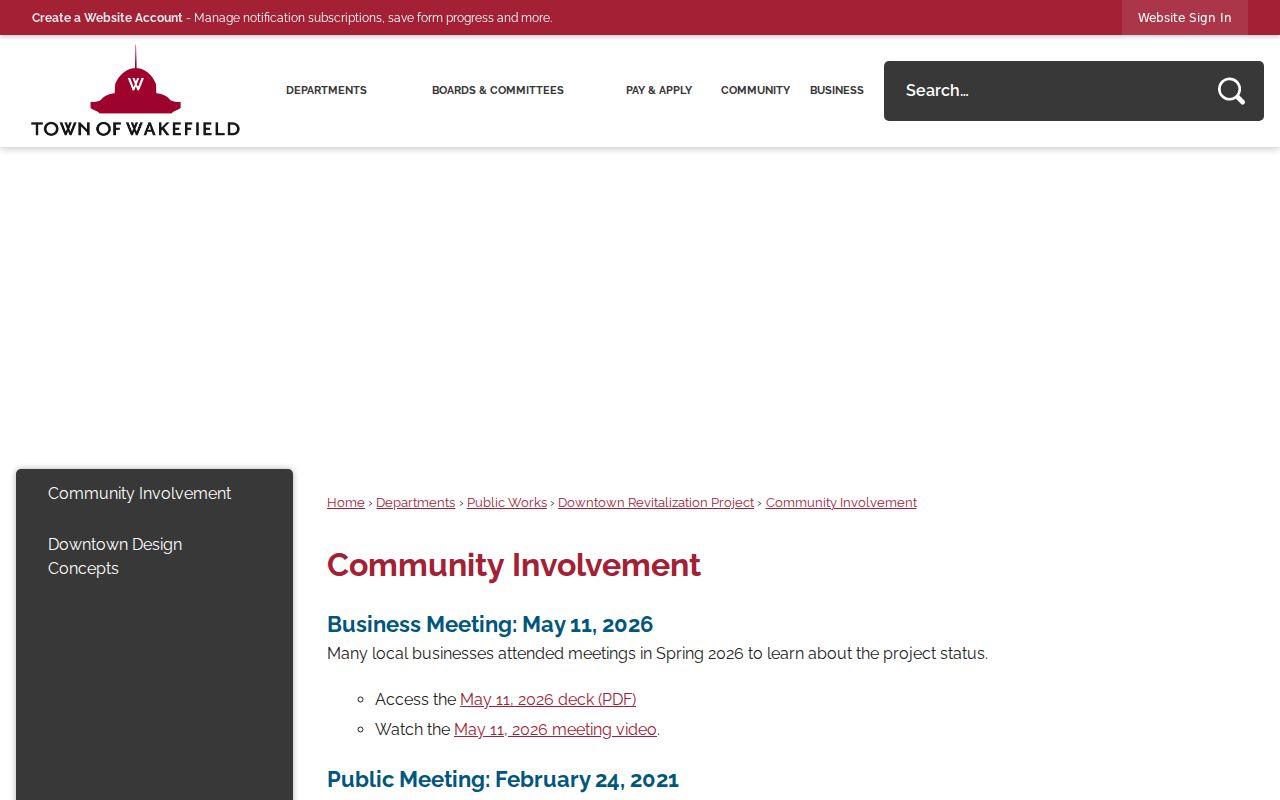
Use a public organization listing to find an institution’s stated contact or activity. Do not translate a public group name into an assumption about any person’s membership, address, or participation.
Wakefield Neighbors Without a Member Roster
Beebe’s Join In Wakefield directory is searchable by Arts, Culture, and Hobbies; Civic, Community, and Historical; Educational; Human Services; Municipal, Politics, and Advocacy; Religious; Science, Nature, and Animals; Social; Sports; and Youth categories. A listed nonprofit must have a significant Wakefield nexus, and the library says inclusion is not endorsement. Those categories are a way to identify the right community institution before making a public inquiry.
The distinction is important. A community directory is an institution finder. It is not a private directory of households. The Historical Society’s maps, documents, and photographs can also help with an old address or place reference, but should be requested as collection material rather than treated as a current-neighbor source.
Official and Commercial Block Sources
Official records and commercial block reports are different categories. The official route shows a source, a custodian, and a record-specific limit. Commercial reports may combine property, directory, and marketing data, but can be stale or merge people with the same name. Use a report as an unverified lead only, then verify the underlying parcel, voter, deed, library, or civic source.
| Source category | Best use | Key limit |
|---|---|---|
| Official parcel and deed records | Property and recorded-instrument questions | Owner or mailing information does not establish every occupant |
| Municipal voter list | Lawful registered-voter record request | Not a complete household roster; protected data is withheld |
| Library and civic sources | Historical context and institution contacts | Organization listing is not membership evidence |
| Commercial block reports | A prompt to check a primary source | May be stale, merged, incomplete, or inconsistent with protected records |
Wakefield Community Labels Need Boundaries
Wakefield Center, Lake Quannapowitt, Greenwood, Crystal, downtown, Main Street, Albion, Water, Lake Avenue, and the West Ward School appear in local-history and civic materials. They are useful documented place references for a map, history, or organization search. Formal neighborhood boundaries for those labels were not located in the inspected sources, so they should not be presented as exact territorial lines.
Use the label from the source, then turn to the parcel map, organization, or historical collection for the precise question. This avoids treating a familiar local name as proof that every nearby parcel belongs to a formally defined neighborhood.
Note: A community label is a search term and context clue, not a substitute for parcel or boundary evidence.
Privacy Limits on a Wakefield Block
Some of the most personal block details remain outside ordinary public research. Non-owner occupants, children, protected voters, Address Confidentiality Program participants, phone and email data, utility accounts, delivery records, and private association membership do not become public merely because a nearby parcel can be mapped. Massachusetts voter guidance and confidentiality rules require protected records to remain protected.
Absence is not evidence. A missing name may reflect a protected address, record timing, a limit on the requested record, or a source that never collected the information. Do not try to infer a protected address from a deed, directory, map, or cross-reference. If a public entry is inaccurate, take the correction question to the original custodian.
Lawful use. Use Wakefield neighbor records for personal, lawful research and community context. Do not use information from them to stalk, harass, intimidate, or harm another person.